Total Pageviews

Showing posts with label Calum Maclean. Show all posts

Sunday, 26 December 2021

Tales of a Badenoch Deerstalker: Finlay Mackintosh of Insh

On his return from a ten-and-a-half month sabbatical in Sweden, Calum Maclean returned to the Scottish Highlands in the summer of 1952. On 16 July 1952 Maclean noted in his diary:

A year has passed since I last wrote a word in this diary. Since then, I’ve spent ten and a half months over in Sweden, at Uppsala. I arrived here at Sliabh na Sròin or as they call it Baile Ùr an t-Slèibhe, Newtonmore, a week ago. I’m now prepared to have a go in Badenoch. There are not many of the old folk left in this place and the tradition bearers stay far from one another. But we must try. I’ve already seen one or two folk but I’ve not yet met that many. I spent a while writing this morning and especially writing to Uppsala in Sweden. After lunchtime, I went to Kingussie and visited Mr Lachlan MacEdward who belongs to Inch and was for a long time a minister over in India. He speaks Gaelic although he spent a long time overseas. I was told that he has a great interest in stories and old lore. When I arrived he was preparing to go to Edinburgh. We spent a while conversing and I said to him that I’d come back to see him at the same time this coming week on Monday. After I took my leave of this fine fellow, I went out the Inch road and reached Tromie Mill where there has been a mill for over a hundred years. This was the last working mill in this part of the country. I heard that there was an old woman there, MacGregor’s wife. She had stories and lore. That was right, too. I went to her house about three o’ clock in the afternoon and I was in her company until nearly six o’ clock. She was an old woman with a stoop. She is now eighty-six years old and she has only her son for company. She gave me plenty of lore and I wrote down parts of this from her recitation as well. She also gave me names of other folk in Druim a’ Ghiuthais who spoke Gaelic. There are more [Gaelic speakers] than I had originally thought. I said that I’d come back to her this coming week. I returned to Newtonmore about seven o’ clock. After dinner, I went to see William MacKillop, an old baker belonging to Laggan that stays in Newtonmore. He gave me stories but only in English. He was only seven years old when he left Laggan. At any rate, he told me good stories. I got home about eleven o’ clock at night.

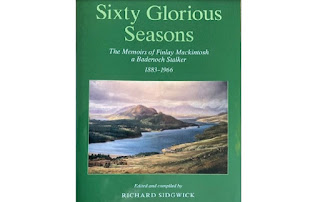
It was a good start and Maclean also noted, presumably with some satisfaction, that he had found more Gaelic speakers then he was expected at least amongst the older cohorts. One of quite a few folk from whom Maclean recorded the traditions of Badenoch one of whom was a character called Finlay Mackintosh, a veteran gamekeeper of nearly fifty years. A few briefs facts about Mackintosh may be given as related in a book, Sixty Glorious Seasons: The Memoirs of Finlay Mackintosh a Badenoch Stalker, 1883–1966, edited and complied by Richard Sidgwick, which appeared only last year. Finlay Mackintosh was born on 1 May 1883, some two miles north of Insh at Balnespick, which was a let farm on the Invereshie Estate, then owned by the MacPherson-Grants of Ballindalloch. His parents were John (1852–1937) and Mary Mackintosh (née MacGregor, 1897–1955), from Aberlour and the 1891 census states that he was the middle of five children, Mary and Alexander who were older, and Christina and Jessie who were younger. Finlay’s father is described in the 1891 census as a ‘Gamekeeper’ and later, as ‘Labourer’ and ‘Roadman’ at Insh and Easter Inveruglas. Finlay Mackintosh married Elizabeth MacWilliam from Aberlour in 1909 with issue: George John (1910–1944), Elspeth Mary (1911–1993) and Eileen Elizabeth (1913–1993). He served in the Lovat Scouts sharpshooter during World War I and was stationed in France and was demobbed in 1919. Mackintosh eventually, on the retirement of Donald Crerar, was appointed head stalker at Ardverickie Estate in 1935, a position he held until 1961. He wrote his memoir from then until 1963 and passed away in Inverness in 1966.

By the time he was recorded by Maclean his ability to tell a story was already apparent. The following five items are all local and naturally enough involve his own experience as a gamekeeper, the two of which focus on a couple of local characters, two involve deer and the final one concerns the tragic loss of children in a storm. A few things may be observed about the following tales is that the narrator knew intimately the local history of the area, he knew very well the habits of deer and the local geography. It appears that he knew Gaelic but perhaps wasn’t used to speaking it too often and this is perhaps the reason why he may have preferred to have narrated his stories in English with the occasional Gaelic phrase or quote thrown in for good measure. All the following items were recorded on recorded on 12 July 1952 and transcribed shortly thereafter.


SEÒRSA MÒR DAIL ANNACH


It would be a pity to lose these stories about Seòrsa, because this is no myth now about Seòrsa. There are lots of people alive yet who remember big George. And George was a relation of my own.

Well, I remember the day he was found under the snow, the day before he died. That was in 1894 – the year of the big storm. He had been to the “local.” He had taken a little too much and he was walking home five or six miles to Bail’ Ghiuthais where he was staying at the time. And he was overcome with – I don’t know whether it was the storm or that he had too much to drink. But anyway he lay down about a mile above the hamlet of Inveruglas. That was on Saturday night. He didn’t arrive home on Sunday – at Baleguish on Sunday. And nobody worried very much because it was nothing unusual for George to be a day lost. But when he didn’t turn up on Monday, the shepherd with whom he was staying was making enquiries and it was learned at the local inn at Insh that he had left on Saturday night. So search parties were organised and they looked in all directions. And towards the afternoon of the Monday one party came on George lying partially covered with snow. He was alive, and in his oxter was a bottle nearly empty. He was taken home – he was taken to the nearest house and warmed up and attempts were made to revive him, but he died during the night.

He was an extraordinary man George. He wasn’t very tall – about five feet ten I think and he was very, very strongly built. And when he was standing perfectly straight he had extraordinary long arms. He fists were just on a lever with his knees. He was very, very broad. I believe that, if that man was living today, when we know so much about physical culture and one thing and another that he would have been easily the strongest man that ever lived. As it was I am not sure but he was without any doubt. There was something wanting in George. Nobody could point the finger on the want. He was working on the Highland Railway, when it was being built, for some time. He never worked any job for very long. But his job was carrying and laying rails and he was doing what just took four ordinary men to do, whether he was carrying part of the rail or something like that. But in any case he was earning four men’s pay. And in those days it wasn’t “pay as you earn”: it was pay as you work. And George was getting four men’s pay. But he never stuck the job for very long. Whenever he collected a few pounds he would take off and have a booze, booze for two or three days till the money was done. Then he would start working again. But naturally when he gave up one job he had to start anew. So often giving up working on the railway, a favourite job of his was digging out fir trees, for in those days fir roots were used not only as fire lighters, but for the same purpose that electric light and paraffin lamps are used nowadays. There weren’t lamps in every house and there was no paraffin oil in those days so a very common illuminant was just bundles of fir stuck in the old irons at the fireside. They gave very good light. In casting fir ordinary men would take two or three hours digging the clods away from the fir and leaving it exposed, and perhaps yet it turned all together. But with George he just located a stump of fir somewhere in the peat-moss and if there was enough exposed for him to get a hold, he just simply caught the one end of it and turned it up earth and all. He took the whole lot out without any digging. It doesn’t matter how deep it was, out if came if George could get a good hand-hold. He worked at that job for a spell every summer, at the beginning of summer – the peat-casting time. He was engaged to cast so many stocks and get so much for stock or a day’s pay which was even greater. He would work at the fir-stocks for a few days. When he would have some money he would have another booze. It was the same with every job. He would just work a few days.

But on one occasion he went to the market at Kingussie. In those days the market day was the event of the year. There was no circus, cheap railway, bus fare and that sort of thing. The market day was the holiday. Farm-servants would be engaged and lots of business would be done. All the ladies in the country would gather to Kingussie. And it was a great thing in those days to give fairings to the ladies. And the ladies weren’t bashful to ask for fairings, and even a stranger was asked for fairings. And a lady’s popularity was judged by the amount of fairings that she got. It was also a very useful day for the recruiting sergeant. He picked up quite a number of recruits on the market day. There would be drams going and the devil-may-care spirit would seize the young fellows. They would take the King’s shilling and before they know where they were they would be enrolled in the army. They would, of course, regret it when it was too late. The drill sergeant came across George. Gosh! he thought this would be a grand recruit to have. George was half-drunk as usual. He took the King’s shilling without any consideration at all. In due course he was drafted to Jamaica along with a battalion of the Camerons and was held there an foreign duty. Jamaica was rather a dull place But sports were organised, and in this case he entered. The soldiers had training. And at that time in that particular battalion of the Camerons there was a famous boxer. He was heavyweight champion of the British army at the time. And some of the officers thought that this would be grand sport, if they put George Cameron and the boxer to have a bout. But poor George didn’t know anything about boxing, but however, he was quite game to take the man on. And, of course, when the fight was in progress the boxer could hit George when and where he would. George put up with this for some time, but at last he got one blow and the boxer collapsed. And so great was the force that he put behind the blow that his right foot went through the platform that he was standing on And the boxer collapsed on the platform and according to reports the boxer never moved, whether that’s correct or not. George won the fight and there was a court martial and George was discharged. He was a bit of a poet, George, too. And I remember long, long ago hearing a poem that he composed about the boxer that he had fought with. It worried him a great deal that he had killed the boxer, but it never showed except when he was half-tight. He composed a poem about the do he had with the boxer. I remember just a few lines of it Gaelic and it was something like this.


Taing don Rìgh air a’ chathair

Thug e paidir math dhòrn domh,

Agus taghadh na misneachd

An àm na trioblaid bhith tòiseachadh.


Do you know what that means? “Thanks to the Lord – I expect he meant – He gave me a pair of good fists and the best of courage, when trouble was brewing.” There were some very good verses in it but that is all I remember.

On another occasion he was sitting on the parapet of a bridge at Insh. Penny’s Bridge and it is called Penny’s Bridge to this day. And at that time there was an inn at the bridge. And George was just at that miserable stage recovering from a bout of booze, and he was sitting on the parapet of the bridge with his head down and very, very unhappy. And who came along but Macrae, Nuide, the late Macrae’s grandfather – MacCormack’s wife’s great-grandfather. He was riding on a white pony. As he was passing George looked at him and he made a very sarcastic remark to George: “I am surprised at you, George, being in a state like this spending your health and money in drink like this.”

George said nothing but leaned across and caught Macrae by the ankle and lifted him up off the saddle just with the one hand, lifted his saddle and all. The stirrup seems to have been stuck in Macrae’s foot, but he burst the girth that was holding the saddle on to the horse, let him down in his back on the road and then scrubbed the road with him: “A-nis, a bhiast bhodaich, cha do ghabh mise gnothaich riu-s’, Na gabh gnothaich rium-s’.” “I didn’t interfere wi’ you. Don’t you wi’ me.”

On another occasion he was crossing the River Feshie to a sheebeen that was on the south side to spend the night there half-tight as usual. And the owner of the sheebeen said to him: “The river has risen. It is a wild night. You can’t go home tonight, George. It is as much as I could do to cross that river myself.”

George said nothing but caught up the tavern-keeper in his oxter, waded across the river, laid the man down on the other side: “A-nis, a bhiast bhodaich, theirg dhachaigh.” “Now, you miserable fellow, go home.” he said.

There are three stones in the Comhraig – that is the tributary of the Feshie – huge boulders. They were carried there by George. He was living in Baleguish at the time. That is just across the river. When he was going to Kingussie or to Insh he had to cross the river. There was no bridge then. And to save himself getting wet he put in the three boulders – enormous things. They must weigh something like half a ton each. They are still there and have been there for the last seventy years despite floods and rains. And they are still just perfect for stepping across for an ordinary man. There was a stone at the Duke of Gordon for many years. I remember perfectly when it was there. And George carried that stone from Ruthven to the Duke of Gordon Hotel just for the strong young men of the town to try their strength. And there wasn’t a man in Kingussie in Eòghan Campbell’s time that could put daylight between the stone and the ground. And that stone must be still there unless it has been put out of sight, when they were rebuilding the Duke of Gordon, which they did about forty years ago. I don’t know. but I remember, when I was young, seeing the stone quite well. Well, there wasn’t a man in Kingussie and there was some very strong men in Kingussie at the time. Ewen Campbell was one of the strongest figures here at the time, yet he couldn’t move it. Yet George carried it in his plaid from Ruthven to Kingussie.

There was an old hall table of white wood. It was in Loch Ericht hotel, when Adams was there. When he left it, when Duggie Matheson came twenty four years ago, the table was there then, but I never thought of asking Matheson whether it is still there or not. Well, George used to lift that table He’d catch one corner in his mouth and lift the table up off the ground with his teeth. And the marks of his teeth were in the table. I must ask Matheson if it is still there.

That’s a fear of the most interesting stories that I remember about George. Another one: Now the man that this happened to told me himself. George was going home one night. I expect tight as usual. And he called at Lachie Hutcheson’s house. This was an old fellow that lived in Drumguish. And he wanted Lachie to let him in. He knew Lachie very wel. Lachie said:

“Oh! go home, George. I can’t be bothered. I have been working and I’m tired and I don’t want to get up.”

“Get up or I’ll knock down the house,” he said.

And Lachie knew very well that he would soon knock down the house, if he wanted. So he got up.

“I’m going in,” George says, “and sit in your house. I’m not going home tonight.”

“No, you’re not coming in here you haven’t very far to go. So.

“I’m going in Lachie,” he says. “So he caught me by the arms,” says Lachie. “And the marks – the blue marks of his hand was on my arm for a week afterwards. And he only just caught me gently,” he says.

Big George was most gentle when he was in his working mood – that when he wouldn’t have any booze – all the kids in the country would be around him. He was delighted to have the children round about him. All the bairns in the place would be where George was working. He never harmed a soul if they left him alone.

Dail Annach is a quarter of a mile below Cuaich on this side of the Truim. It is a flat dell just below Cuaich. George had no family. He never married. There’s nobody belonging to him living. I think his nearest relative was my mother. The Camerons to which George belonged came from Rothiemarchus. He died in January, 1894. I remember seeing the people going out to look for him. I was eight years of age then.


FINLAY MACINTOSH ATTACKED BY A STAG


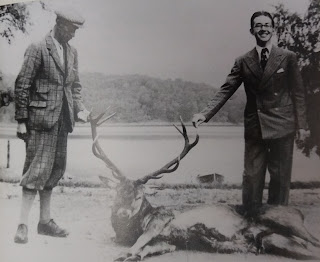
I have been attacked just twice in my lifetime by stags. The first time – a good many years ago now – I was out shooting grouse or trying to shoot grouse, rather, in the month of October. And at that time they are very, very wild as every sportsman knows. The best time to get them at that time of the year, when they turn wild, is just half an hour after daylight. On this particular morning I had gone to a certain part of the moor where there were lots of little knolls, a favourite place for grouse to be crowing in the morning, and I came on to the top of a little knoll: gun ready expecting a grouse cock to rise. And just below me I saw a stag very, very angry. He had evidently been driven from his hinds during the night by a rival stag. He was tearing up the heather with his horns and pawing the ground with his feet and behaving just like a real angry beast. So after watching him for a while I gave him a shout. He lifted his head, looked in my direction, saw his form on the skyline and came dashing up that slope like a streak of lightening. He was a very good stand and I was loath to shoot him and I did my best to try and scare him away. But he never paid any attention and when he was just within a yard of me I fired at his face and killed him on the spot, of course. He actually struck me as he fell dead. Now that stag had no idea he was charging a human being. He didn’t wait to see what he was charging. He saw the form on the skyline and evidently thought it was another stag. He charged. I was very sorry to have to kill him, but it was either him or me.


SEUMAS DAIL CHAORAINN


You would have heard of Seumas Dail Chaorainn the famous poacher He was also known as the Munchausen of the Highlands. He had an extraordinary imagination. He was out on a poaching expedition in Gaick. Gaick was one of his favourite places to poach in. And he was hoping to get some venison about the Dubh. That is a hill about a mile or so past Gaick Lodge. And he saw some hinds in the Dell there. When he got within shooting distance of the hinds, he was surprised to see several ladies dressed green sitting beside the hinds and milking them. Well, he looked and was very much puzzled and perplexed over the whole thing and wondering what on earth was happening. Was he seeing straight? But presently the ladies in green just disappeared and the hinds went on grazing. So after a bit he fired at a hind and dropped her. And he went up to gralloch her. And while gralloching he was very much surprised to find that instead of milk coming out of the udder, as usually comes from the hind, it was green thread that come out of the udder. It was quite plain where the ladies who were dressed in green were getting the thread to make their dresses with.

On another occasion he was out on a poaching expedition an Tromie side. And he saw a roeback across the river. And he was determined to have the buck He sat down and got his gun trained on the roebuck and fired and as the bullet was crossing the river a salmon jumped out of the pool. He killed the salmon and killed the roebuck. And the recoil from his gun was so great that it sent him staggering backwards and he sat down on a covey of grouse. So that he had two and a half brace of grouse and a salmon and a roebuck with the one shot. And “Tha sin cho fìor is a tha mise ag innseadh dhuibh, fhearaibh.” “That’s as true as I am telling you, lads.”

That’s two of Seumas Dail Chaorainn on another occasion he was out stalking in Coire Bran. There were two or three other fellows along with him. And in those days it was the custom for two or three or however many was in the party to fire, all fire at the one blast.; The rifles of that day weren’t very accurate, and they wanted to be sure of, at least one. Well, it was James’s turn to hold the pony. And while the other three were away looking for the venison the mist came down. Dail Chaorainn was wondering that they weren’t coming back and all of a sudden his pony sprang in the rain, ran a few yards and dropped dead. And he heard two or three shots. His pals had mistaken the pony in the mist far a deer and fired at the pony instead and killed it. The pony’s bones are there to the present day at the foot of Minigaig Pass in Coire Bran. The extraondinary thing is that James Dail Chaorainn was standing holding the pony’s bridle at the time that the bullets hit him and he was unscathed. Now that is not one of James’s. There is no imagination there. That is a true story.

I don’t know did I tell you about his experience with the witch Cnoc Fraing. He used to go to the Dulnain to poach sometimes One this particular morning he discovered that he had come away without matches or tobacco. And he wasn’t at all pleased at having to spend the whole day without a smoke. But just as he was considering going back for his tobacco and his matches he saw a hare. He fired at the hare. Nothing happened. He was a good shot, you know. He reloaded. The hare wasn’t very much scared, sitting quite content viewing him from a short distance. So he reloaded his piece and fired again. Still nothing happened. Then it dawned on him this must be the witch of Cnoc Fraing. So with his next charge instead of putting lead into the gun he put in a small silver coin. He fired at the hare and killed her stone dead. And in going up to pick up the hare he found that this was the witch of Cnoc Fraing and in her paw was a quarter of tobacco and a’ box of spunks.

Of course it was well known that nothing but silver bullet would stop a witch. And the witches seemed to prefer the form of the hare.


THE WHITE HIND OF BEN ALDER


I was telling about the White Hind of Ben Alder. There is nothing extraordinary about that. Ben Alder has still got a white hind. We have got white hinds occasionally and also a nearly white stay about Ben Alder and Ardverikie for the last twenty years white roedeer are also seen here.


LOCHAN NA CLOINNE CAOMH


I think I told you something about Lochan na Cloinne Caomh on Ben Alder. Well, Lochan na Cloinne Caomh is a little corrie just opposite Coire Bhacaidh (Coirevarkie) and has got its name from a somewhat pathetic incident. One time about 1836 Ben Alder was heavily stocked with sheep – lots of sheep and very few deer. And there was a shepherd living at Green Bay about a mile below the present Ben Alder Lodge. And during the lengthy summer days it was quite a common thing for his two little girls to walk up the lochside to meet him, when they expected him to be coming home. And on this particular night at the beginning of summer for some reason or another the shepherd shifted his sheep-stocks to more sheltered ground probably because he was expecting a storm. And he didn’t come home at the usual time, and he didn’t come home the usual way. But the children set out the usual way to meet daddy coming home. And they wondered up the path till they were opposite Coire Bhacaidh and by that time night fell and the storm came on. And between darkness and fear and one thing or another the children wondered off the path, went into this little corrie perhaps hoping to get some shelter and lug down there. The shepherd came home. The first question the wife asked was:

“Where’s the children?”

“Oh, I don’t know. I didn’t see them.

“Oh! but they went away to meet you.”

“But I didn’t come home the usual way,” he said. “I came across from Loch Puttockside.”

“Just have something to eat and go on look for them. They went be far up lochside.”

So he went away as far as he thought it was possible for the children to go, no sign of them! He came back in the middle of the night hoping the children were home. No sign of them. A search was organised at once. It took some time to do that because there were very few people nearer than Dalwhinnie. And by the time they got a search party together it was next day. And they searched along the lochside all over the place and found nothing. The following day they came on the two little kiddies at Lochan na Cloinne Caomh locked in each other’s arms, both dead. They died of exposure. The corrie has been called Lochan na Cloinne Caomh ever since that day. It is just opposite Coire at the foot of a hill called Beinn Bheol. It is just at the foot of Sròn Drèineach.


More is the pity that only these five narrative were recorded from Finlay Mackintosh at this time. Undoubtedly he had more to tell but Calum Maclean was pushed for time and so could only manage so much. Nevertheless, Mackintosh would have seen the benefit of such a process and he had enough ambition and insight to see that if such stories were never recorded then they would have been lost. Perhaps this was at least one of the motivations that he had in mind went he settled down to write down his own memoires, written in his own words which have some of style of his spoken words as given above. Some mark of the man may be found in two obituary notices published shortly after his death, one of which was submitted by his daughter:


Mr Finlay Mackintosh – Deerstalker


The death of Mr Finlay Mackintosh, Adrverikie, Kinlock-Laggan will be regretted by many, both in Badenoch and far beyond her borders, for he was the example of the best type of Highland gamekeeper and deerstalker and as such, his reputation was high and his friends were legion.

Mr Mackintosh died in The Royal Infirmary, Inverness on Sunday. A native of Insh and in his 83rd year, he retired in 1961 after 61 seasons on the hill. From 1900 until the outbreak of World War 1 he was the gamekeeper with Sir George Cooper at Glenfeshie and since 1919 after war service the Ramsden family as keeper and stalker at Ardverickie.

A quiet spoken man with a gentlemanly bearing and a keen sense of humour, this Highland gentleman was well known and highly respected. He was a great sportsman and an acknowledged expert with both rifle and gun. In his long career he won more than 100 trophies for marksmanship, the first when he was a corporal in the Cameron Volunteers at Kingussie in 1904. He was a member of the Scottish International Clay Pigeon team for 25 years and captain for a considerable period.

Because of his wide knowledge of red deer, Mr Mackintosh was for a time a member of the Red Deer commission and he fought for and was successful in obtaining a closed deer shooting season.

In 1927, he accepted an invitation from The Maharajah of Alwar to spend a holiday in India where his prowess with the gun enabled him to shoot a number of tigers and panthers.

During his retirement Mr Mackintosh continued to take a close interest in sporting activities and acted as secretary of the Dalwhinnie Gun Club. A keen follower of shinty, he seldom missed a local match. In his youth, he had been a member of the old Alvie and Insh team. He was well versed in all current topics, a well-read man and an interesting and intelligent conversationalist. Shortly before his death, he completed writing a book to be called “Sixty Glorious Seasons” which his daughter, Mrs Eileen MacPherson, Glenisla, Dalwhinnie hopes to have published.

Mr Mackintosh who was predeceased by his wife in 1952 is survived by his two daughters, Mrs MacPherson and Mrs MacKenzie, Llanbryde.

The funeral to Laggan churchyard was largely attended, a memorial service being held in Laggan church. The officiating Ministers were the Rev. James Currie, Laggan and the Rev. James Murray , Newtonmore.

Reproduced from The Strathspey and Badenoch Herald 25 March 1966


Death of Finlay the Stalker

By Eileen MacPherson


Finlay the stalker died in the middle of last month at a time as graceful for his exit at his eighty-three years had been among the mountains and deer forests of which he had been a part.

For the record, he was an international shot, a grey eminence for the Red Deer Commission, a hero of the Carnegie life-saving awards. For his friends, he was the courteous host and the kind of company that never palled, either in conversation or in the silences in which he could wrap himself with the same panache with which he wore the Ardverickie checks of his stalker’s tweeds. Only a bony six-foot-two with the outrageous permutation of green, brown, and white that blended with the whipped steel of Loch Ericht, the sombre pines and the bride paths leading to the forest beyond.

With the end of his life, the chapter of the great day of the Season close. “Sixty Glorious Seasons” is the title of the book he was writing and that sums up an epoch in Highland sporting history irrevocably vanished, for it depended on the now extinct, rich and exotic to give it that quality both savage and sophisticated which accorded with the fantastic setting where, for two months, men hunted, acknowledged danger and drank like gentlemen.

In Finlay’s stone-flagged kitchen were all the trophies of the chase. Home cured deer skins lay on the floor, ornaments carved from antlers were scattered on tables and the mantleshelf. Finlay wore cufflinks made from the vestigial ivory deer tusks. In the sitting-room, furnished with prim conventionality there was a lustrous skin of a tiger shot by Finlay when he was a guest of The Maharajah Alwar – one of a procession of illustrious tenants – with whom he had gone out to India.

His accounts of his Oriental safari linger in the ear of recollection as much for the seductive beauty of his voice telling them as for their Munchausen content. Since he was tall, gaunt and dignified, it seemed impossible to connect him with the impish stories of Annie, his supra-intelligent elephant who kept throwing stones at an oncoming tiger until Finlay took accurate aim.

But then it was also difficult to realise that the man who walked all through a dreadful winter night with Danny, his garron, to rescue climbers lost on Ben Alder was the same as the one who chugged through the summer forest on an ancient B.S.A. with his Cairn terrier sitting on the petrol tank or drove a two-seater car called La Ponette, so constructed that its dickey resembled a bustle. Finlay bought the vehicle for £15 at a time when wages were counted in shillings. Its skittish scarlet accommodated himself, his dog and that quaint conglomeration of trappings which 10 years ago were necessities for living in Badenoch’s rugged isolation.

Now he is dead. May he have his share of Paradise.


Written by his daughter and published in the magazine ‘In the Country.’ Reproduced verbatim.


The above five stories recorded by Maclean add another dimension to those included in Mackintosh’s memoir and combine to give a fairly well rounded portrait of a man who spent more than half century as a Badenoch deerstalker and who when the occasion was called upon could tell not a few captivating yarns.


References:

CIM I.I.13, TSB 13: pp. 1154–73

Michael B. Brown, “White Red Deer: Legend, Myth and Fact”, Deer: The Journal of the British Society, vol. 9, no. 6 (1995), pp. 370–72

(Sir) James Ferguson, The White Hind and Other Discoveries (London: Faber & Faber, 1963)

Finlay Mackintosh, Sixty Globrious Seasons: The Memoirs of Finlay Mackintosh a Badenoch Stalker, 1883–1966, ed. by Richard Sidgwick (Glenisla, Newtonmore: Cameron Macdonald)

NLS MS.29795, 1r–162v [Calum Maclean diaries 1951–54]


Images:

Sixty Glorious Seasons by Finlay Mackinosh

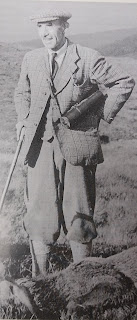
Finlay Mackintosh


Tuesday, 29 October 2019

Local Hero: Big Young Donald MacMartin-Cameron

Almost everywhere in the Highlands and Islands there used to be what may be termed a local hero or, perhaps more precisely, local heroes. These were celebrities of their day who won renown through their various talents, or brave deeds and, on the reverse side of the coin, there were also anti-heroes who gained notoriety for vile or cowardly behaviour. Various heroes of different cultures can be identified throughout human history and literature and one such study, which remains a classic, is Joseph Campbell’s Hero with a Thousand Faces, first published to critical acclaim in 1949, which uses comparative methodology to closely analyse the archetypal hero found throughout world mythology.
Keeping with a Gaelic perspective, in many ways an heroic ideal chimes with one aspect of a binary division which runs in parallel with the so-called panegyric code. It is a a deeply held perception (or conviction) of how, in many respects, the Gaelic world was (and still is to some extent) perceived or viewed, perhaps through its (seemingly all) pervasive use by poets, song-writers and storytellers. In simplistic terms it may be split between praise (moladh) and dispraise (di-moladh) and it seems that not many people or objects were not beneath the attention of a skilled (or even an unskilled) bard. Witness, for example, many people or things that have attracted disproportionate praise or stinging satire. These include but are not limited to such subject-matter as bagpipes, whisky, wine, tobacco, hunters, tea, women, horses, rats, mice, cows, sheep, sexual parts, ships, mountains, islands, clergymen, poets, factors, chieftains and the list goes on and on. Indeed it would be far easier to produce a list based on one of exclusion rather than inclusion. Such creative output could be scathing, witty, scatological, biting, beautiful or moving. Clearly such productions were aimed to get an audience to react emotively whether that be in a positive or a negative manner. It was and is powerful stuff.
One such local hero from Brae Lochaber was evidently a man known as Dòmhnall Mòr Òg (‘Big Young Donald’), a MacMartin-Cameron from Leac Ruaidh, Glenroy, right in the heart of MacDonald territory. Many stories were related about him; some of which may be true but others would seem to have been attached to his personality. John MacDonald of Highbridge, Brae Lochabrer, alone had nearly a dozen anecdotes about him. During the tenureship of the Gordons over Brae Lochaber, Big Young Donald was a factor for the estate. This indicates that he had some formal education and, that being the case, was literate in English and perhaps even in Gaelic. He flourished during the first half of the eighteenth century and was considered to be a great hunter, far superior to his contemporaries. A dialogue song between him and a deer is also said to have been composed by him. He was clearly a popular personality for, on his death, an elegy was composed for him and ascribed (probably incorrectly) to Alasdair MacKinnon by the Rev. Alexander Maclean Sinclair (1840–1924). The elegy has been printed on a number of occasions for which see Anon., 1895, p. 8; Broadwood et al. 1931, pp. 280–303, where the air is given and a translation provided by Frances Tolmie; Carmichael (1928–71), v, pp. 174–77; Ailean Dughalach (1829), pp. 127–31; Sinclair (1890), pp. 37–39; and Mac-an-Tuairneir (1813), pp. 372–74. It also continued in oral tradition and was recorded from John MacDonald of Highbridge, wnho may be heard relating a similar anecdote and singing the elegy: http://www.tobarandualchais.co.uk/fullrecord/22888/1; as well as http://www.tobarandualchais.co.uk/fullrecord/51616/1.
Indeed, such a figure clearly made an impression on Maclean for he wrote in The Highlands (1959) about him most of which was gleaned from John MacDonald, previously mentioned:

About the most noted of Lochaber’s local heroes was Donald Cameron who was factor to the Huntly and Gordon estates in Lochaber during the early part of last century. In tradition he is known as Dòmhnall Mòr Òg (Big Young Donald). He was a powerful figure and an unsurpassed marksman. Many stories are told about him, some of them quite remarkable. A very fine elegy was composed on his death. It ran into sixteen stanzas, and was very popular with old Lochaber singers. One man came into possession of a copy of several stanzas of the song, which were written down in Cape Breton from a descendant of Lochaber stock and mailed across the Atlantic. He was extremely proud of his acquisition and showed the copy of the song to everyone he met. Then one day he met John MacDonald of Highbridge. They met half-way across the bridge at Spean. The copy of the song was produced and the old man read through the five or six stanzas. The other listened with interest and patience. When he finished, John was asked if he knew the song. He did.
“Sing it then,” said the other.
John put his back to the parapet and went through sixteen verses. The other crumpled the paper he held into a ball and threw it into the Spean.
“To the house of the bitch with it!” said he. “That is only half the song.”
The old man was illiterate according to modern standards, yet one song meant as much to him as a herd of prize cattle. So much for the barbarism of the Highlanders!
A story goes that a spirit used to meet Dòmhnall Mòr Òg and it told him when he would die.
“The wife will tell you,” said the spirit. “She will let you know when you are going to die, for you will ask for something and will not get it.”
“In that case, I shall take good note of it,” said Donald. “The wife never refused me anything, but was always good and kind to me.”
“Oh!” said the spirit, “put not your trust in a broken sword. Do you not know that it was the woman who was fanning the fire with her apron when Christ was being crucified so that the smith should make the nails to go in His hands and feet?” The smith said:
“I am afraid that we have not enough fire for four nails.”
“Oh!” said she, “what need have we of four nails?”
“Yes,” said he, “we need four.”
“Put one foot on top of the other and drive the nail through the two and that will secure them,” said she. “You need no more than three nails.”
“Oh! woman,” said he, “in every difficulty in which you ever were there was always a tongue in your mouth to get you out of it. It will be so. There will be only three nails.”
And to this day women are forbidden to fan the fire with their aprons, and they will on no account do it. They all know about this.
The legend about the nails in the Cross is known in many European countries, but the number of nails varies. In Gaelic tradition the woman is invariably master of every situation. “Why is a woman like an echo?” asks the Gaelic riddle. “She will have the last word in spite of you.”
It appears that Dòmhnall Mòr Òg was very fond of the fair sex and his reputation lived long after him. Fifty years after his death and burial in the churchyard of Mucomer, a crofter in the neighbourhood had a very troublesome ram which always chased women, never men. The ram’s behaviour seemed inexplicable until one of the local characters ventured a serious and plausible suggestion.
“Perhaps,” said he, “the ram is really Dòmhnall Mòr Òg.”
The belief that spirits of the dead return in animal form is widespread; it is by no means Highland or Lochaber superstition. Actually there is surprisingly little of what may be termed as superstition in Lochaber. There is very much more among the fishing communities on the east coast of Scotland.
I regret that lamentably little of the fine traditions of Lochaber are being passed on to the younger generations. Men like John MacDonald of Highbridge, Archie Maclnnes of Achaluachrach and the late Allan MacDonell of Inverlochy could stand anywhere on the highway between Fort William and Roy Bridge and name every valley, every stream, every copse and every peak in an absolute sea of mountains as far as the human eye could reach. Their knowledge did not, however, stop at mere names. They knew the why and wherefore of them all.

Apart from updating the orthography, these anecdotes about Dòmhnall Mòr Òg can be given in the transcribed original, followed by translations:

DÒMHNALL MÒR ÒG
Bha fear ann am Bràigh Inbhir Ruaidh gu h-àrd agus ’s e Dòmhnall Mòr Òg Mac Mhàrtainn a bh’ air. Agus bha an corp aige tighinn a-staigh Gleann na Fionntaig. Dh’òrdaich e a’ cheathrar bu treusa a bhith fon ghiùlan aig Allt nan Reithe. Chaidh a thìodhlacadh ann am Magh Comair, an Geàrr Lòchaidh. ’S e Camshronach a bh’ ann.

BIG YOUNG DONALD
There was a man in up in Brae Inveroy called Big Young Donald MacMartin [Cameron]. His corpse was taken from Glenfintag. He requested that the four strongest men should carry him over Allt nan Reithe [Rams’ Burn]. He was buried at Mucomir, Gairlochy. He was a Cameron.

DÒMHNALL MÒR ÒG AGUS AN SAGART
Bha duine anns an dùthaich seo ris an abradh iad Dòmhnall Mòr Òg de dhuine làidir, comasach. Bha e a’ fuireach san Leac Ruaidh gu h-àrd am Bràigh Ghleann Ruaidh anns a’ chrìoch eadar Bàideanach agus Gleann Ruaidh. Agus cò thachair tighinn don àite ach duine foghainteach, sagart anabharrach foghainteach. Agus bha iad airson gu feuchadh Dòmhnall Mòr Òg an deaghaidh dhà a bhith gràinne bhliadhnaichean an sin, gu feuchadh e fhèin agus an sagart car gleachd. Chan fheuchadh Dòmhnall Mòr Òg e, agus bhiodh e ga fheuchainn. Dh’fhalbh an sagart. Dar a dh’fhalbh an sagart, thuirt iad ri Dòmhnall Mòr Òg, carson nach d’fheuch thu car gleachd seo?”
“An-dà,” thuirt e, “bha an t-eagal orm gum biodh e gu h-àrd agus bha dìreach den olc annam nach b’ urrainn domh bràthair mo sheanar a chumail bhuaidh.”
B’ e sin a’ bhiodag. Ach cha d’fheuch iad car gleachd riamh. Agus a dh’innseadh gun robh an sagart foghainteach: bha gille a’ falbh leis agus nam biodh aige ris an abhainn a dhol seachad air Ruaidh an àite cumhang, freagarrach dha fhèin, bheireadh e roid bheag às agus dh’iarradh e air a’ ghille nan dèanadh e sin fuireach aig taobh na h-abhna. Agus anns an roid san dol seachad bheireadh e air a’ ghille na achlais agus leumadh e a-nunn air taobh thall an uisge agus an gille aige na achlais. Tha mi a’ smaoineachdainn an t-ainm a bh’ air an t-sagart a bha sin gur h-e Burns a bh’ air. Agus bhiodh e a’ fuireachd an Gleann Turraid. Agus tha mi a’ creidsinn gu faod sibh a’ dol air ais dà cheud bhon àm sin.

BIG YOUNG DONALD AND THE PRIEST
There was a man in this country called Big Young Donald Cameron, who was a strong capable man. He stayed in Lecroy up in the Braes of Glenroy in the borders between in Badenoch and Glenroy. And who happened to come to this place but a strong man, a priest who was extremely strong. They wanted him to challenged Big Young Donald after he had been there many years, that he and the priest should have a wrestling match. But Big Young Donald wouldn’t challenge him although the priest was willing to try. The priest set off and as he did, they asked Big Young Donald why he didn’t challenge him to wrestle?”
“Well,” he replied, “I’m afraid that if he got the upper hand then and that I’d have such a bad wont then even my brother’s grandfather couldn’t be kept away.”
That was the name of the dagger. They never challenged one another to a wrestling match again. And to say how strong the priest was: a lad would travel with him and if he had to cross a river such as the River Roy at a narrow place that would be suitable he’d take a small run and he’d get the lad to stay beside the river. And when he took a run as he went by he’d grab the lad and put him under his armpit and he’d jump over the water with the lad still held in his armpit. I think that the priest’s name was Burns. And he stayed in Glen Turret. I believe it’s around two hundred years ago when this is said to have happened.

DAOINE A’ TROD LE BATAICHEAN
Nuair a chaochail Dòmhnall Mòr Òg, duine ainmeil a bha gu h-àrd an Gleann Ruaidh, chaidh fear de na gillean aige fhàgail na àite na rùnair’ aig a’ Ghòrdanach. Agus bha gamhlas aig càch ris gun d’fhuair e an t-àite seo agus ’s ann a chaidh ceathrar an àirde feuch an gabhaidh iad air, agus nam b’ urrainn daibh, a mharbhadh agus gum faigheadh iad fhèin an t-àite aige. Ach bha an duine foghainteach agus dh’aithnich e gur h-e a’ chomhstrì agus an aimhreit a bh’ ann. Agus chaidh iad an grèim ri chèile. Agus chuir e a chùlaibh ris an tallan aige agus ghabh e orra agus chuir e creachdan air an cinn a bha truagh. Thàinig iad a-nuas agus rinn iad a’ chasaid ris a’ mhinistear a bha san àite, duine còir, am ministear Ross. Chaochail e ann an 1822. Ach, co-dhiù:
“Feumaidh mise dà thaobh na naidheachd fhaotainn,” thuirt e.
Chaidh e an àirde a dh’fhaicinn an duine a bha an Gleann Ruaidh. Agus dh’innis e dhà mar a thachair, gun deach iad an àirde ga fhògairt agus a’ feuchainn ri mhilleadh agus an t-àite aige fhaotainn dhaibh fhèin.
“Rinn thu uamhasach math orra,” thuirt e, “is uair sam bith a thèid iad an àirde agus iad ann an coltas comhstrì na aimhreit, na caon am bata orra, ged a dh’fhàgadh tu nan laighe ann an sin iad le ’n cuid fala.”

MEN FIGHTING WITH STICKS
When Big Young Donald MacMartin-Cameron died, a famous man up in Glenroy, one of his lads took his place as the Gordon’s secretary. The rest were envious of him for getting this position and so four went up to threaten him, and if they could, to murder him so that they could get his position. But he was a powerful man and he knew that there was going to be a struggle and fight. And so they grappled with one another. And he put his back to the wall and he attacked them and gave them head wounds that were most wretched. They came down and complained to the local minister, a kind man called Minister Ross. He died in 1822. But anyway:
“I’ll have to hear both sides of the story,” he said.
He went up to see the other man in Glenroy. He told him what had happened – that they had gone up to evict him and to try and destroy him in order to get his place for themselves.
“You did terribly well with them,” he said, “and anytime they go up and it appears there’s going to be a fight or struggle, then don’t spare the stick, even if you leave them lying there bleeding.”

DÒMHNALL MÒR ÒG AGUS AN REITHE
Bha reithe shìos air Magh Comair air an tuathanas. Agus bha an reithe a bha seo crosda agus bhiodh e as deaghaidh duine sam bith a rachadh ron raon thar an robh e. Dh’fheumadh iad a dhol air taobh na fence, mòran dhiubh. Agus bha e tur dona as deaghaidh nam boireannach. Chan fhaodadh boireannach a dhol mar astar dhan raon air neo bhiodh e as an deaghaidh. Tha e coltach gun robh Dòmhnall Mòr Òg car mar sin nuair a bha e òg cuideachd. Bha sinn ag innseadh na naidheachd, is sinn nar suidhe aig taobh an teine mun dol air adhart a bh’ aig an reithe.
“Ma-tà,” thuirt am bodach a bha a-staigh san oisinn – seann duine. Bhiodh e an uair sin a’ dol suas ri ceithir fichead – “tha mise a’ tuigsinn glè mhath cò fear a th’ ann na dè th’ ann. Chan e reithe ceart a th’ ann idir. ’S e th’ ann Dòmhnall Mòr Òg, am fear a bha gu h-àrd an Gleann Ruaidh. Bha am fasan sin aige riamh. Cha do sguir e dheth fhathast. Is tha e air a thìodhlaiceadh am Magh Comair,” thuirt e, “bho chionn ceud bliadhna ach tha an t-àm aige stad dheth a-nise.”

BIG YOUNG DONALD CAMERON-MACMARTIN AND THE RAM
There was a ram over by Mucomir on a farm. And this ram was hot-tempered and it would chase after anyone who went into the field where it was. They would have to keep to the other side of the fence, many of them. And he was especially terrible for chasing after women. No woman could go anywhere near the field or else he he’d chase them. It would appear that Big Young Donald Cameron-MacMartin was quite like that when he was young. We were listening to the story sitting by the fireside and hearing about the ram’s behaviour.
“Well,” said the old man sitting in the corner who would’ve been up to eighty years of age – “I understand very well who that man is or what it is. He’s not a proper ram at all but rather Big Young Donald Cameron-MacMartin, the man who was upon in Glenroy. He always had that habit. He hasn’t stopped yet. And he was buried in Mucomir,” he said, “a hundred years ago but it’s high time that he stopped it now.”

The elegy or lament mentioned above as well as some background information may now be given:

DÒMHNALL MÒR ÒG
Bha duine a’ fuireach ann an Gleann Ruaidh ris an abradh iad Dòmhnall Mòr Òg. Agus mar a fhuair e an t-ainm aige, Dòmhnall Mòr Òg, bha dà Dhòmhnall san teaghlach. ’S e seo am fear a b’ òige bha dà Dhòmhnall san teaghlach. ’S e seo am fear a b’ òige agus ’s e Dòmhnall Ruadh Beag a theireadh iad ris an fhear bu shine. Bha Dòmhnall Mòr Òg na dhuine gu math làidir foghainteach, cho làidir ’s a bha an Loch Abar. Bha e a’ fuireach am Bràigh Ruaidh, àite ris an abradh iad Leac Ruaidh. Air turas dhà a’ dol suas rathad Bhàideanach, e fhèi’ agus coimhearsnach dhà, thadhail iad a-staigh aig àite ris an abair iad Siorra Mòr agus chuir iad seachad an oidhche ann an sin. Na bu dè an deasbad a thàinig eatarra anns a’ mhadainn, na feadh na h-oidhche, bha an fheadhainn a bha a-staigh san taigh a’ gabhail iongantas nach tàinig iad a-nuas a ghabhail an biadh-maidne. Chaidh iad an àirde. Fhuair iad a’ chompach mharbh anns an leabaidh agus an uinneag fosgailte agus Dòmhnall Mòr Òg air adhart. Cha robh iad cinnteach ciamar a bha cùisean a’ dol is cha robh cùisean a’ dol ro-mhath do Dhòmhnall Mòr Òg an deaghaidh sin. Tha iad a’ smaoineach’ gun do thachair an spiorad aig an duine seo air bliadhnaichean an deaghaidh sin agus dh’innis e dhà cùine a chaochaileadh e, agus nuair a thigeadh deireadh a lathainnean. Is suarach a bha e ga chreidsinn. Ach thuirt e ris:
“Ceithir uaire fichead mun caochail thu, iarra’ tu rud air a’ mhnaoi is cha toir i dhut e. ’S e sin crioman ìm,” thuirt e agus:
“O, bha a bhean agam-sa math riamh. Cha dhiùltadh i idir mi.”
“Na cuir thusa earbadh uair sam bith an claidheamh brist na am boireannach. Mar a tha fhios agad, is diugha den teine feàrna ùr, is diugha den digh fìon sean is diugha den domhain an droch-bhean.”
Mar sin dh’aithnich e gun robh na lathainnean aige a’ tighinn gu deireadh. Chuir e fios air coimhearsnach agus thuirt e ris agus thug e làn-earail dha iad a bhith furachail nuair a bhiodh iad ga ghiùlan à Bràigh Ruaidh sìos gu cladh a tha shìos aig Magh Comair ris an abair iad Achadh nan Aibhnichean, iad a bhith furachail a’ dol seachad aig Gleann na Fionntaig air Eas nan Cuilean, gun tigeadh aon spionadh air a’ chiste is air a’ charbad, na daoine bu treasa an Loch Abar a bhith fon ghiùlan. Agus ’s ann mar seo a bha. Dh’fhalbh iad leis. Agus bha e fhèin gu math cinnteach as a’ ghnothach. Bha fiodh, carbad na ciste agus a h-uile dad dhe seo aige air an fharaidh fad seachd bliadhna. Mar a thuirt b’ fhìor. Dar a bha iad a’ dol seachad air an àite a bha seo, thàinig aon spionadh air a’ chiste. Is leig a h-uile nì a bha an ceangal rithe sgreuch mhòr às. Shaoil leotha gun robh e air adhart anns an eas. Chaidh daoine eile gan cuideachadh. Mar sin fhuair iad dhachaigh sàbhailte e chun a’ chill. Agus tha e na laighe ann an sin gus an latha an-diugh. Agus chaochail e ann an 1775. Chaidh marbhrann a dhèanadh dhà agus bheir mi dhuibh facal na dhà dheth agus ’s ann mar seo a tha e a’ dol:

Is goirt an naidheachd a chualas à Bràigh Uisge Ruaidh:
Chaill sliochd Iain ’ic Mhàrtainn guala làidir nam buadh.
’S lìonmhor h-aon a tha cràiteach ri linn do chàradh san uaigh:
’S beag an t-iongnadh do chàirdean bhith an dràsta fo ghruaim.

’S e bhith gad iargain, a Dhòmhnaill, a dh’fhàg brònach an sluagh:
Is lìonmhor maighdeann is bean òg a chìt’ le deòir ’ruith len gruaidh,
Bhon a chaidh do chòmhdach fon fhòd anns an uaigh,
An ciste ghiuthais nam bòrd nach duisg ceòl gu Latha Luain.

Làmh a losgadh an fhùdair an àird nan stùc-bheanna fuar,
’S e bhith gad thogail air ghiùlan dh’fhàg do mhuinntir fo ghruaim.
Is lèir am blàr ann an dùthaich an deachaidh an ùir ort cho luath,
Gum b’ e fear comhairle is rùn thu, a bh’ aig an Diùc san Taobh Tuath.

Is bha thu iriseil, càirdeil, dèirceach, pàirteach ri bochd,
Uasal companta, bràithreil, ge b’ e càs thigeadh ort:
Bu trom torradh do làimhe an uair a thàrradh tu ’n trod –
Bhiodh mòr-fheum aig do nàmhaid air lighich gu càradh an lot.

Is ro-mhath a laigheadh an armachd air slios dealbhaidh an laoich:
Paidhir dhag nam ball airgid ’s iad gun chearb air do thaobh,
Biodag ghlas nan cas charraigneach, bannach, airgeadach, daor –
An àm an ceannach bhon mhargadh cha bhiodh tairgse dhiubh saor.

Thig fèileadh is sàr-bhreacan ort am pleatadh gu dlùth,
Boineid ghorm anns an fhasan air chùl bachlach nan lùb,
Osan geàrr an deagh chadaidh, paidhir ghartan bhon bhùth
Air do chalapannan gasda siubhal ghlac agus chùirn.

Sàr-bhiataiche rathaid air an tathaicheadh sluagh,
Gheibhte saor bho do làmhan gach aon latha a’ toirt bhuat:
Nuair a shuidheadh tu ’d chathair, a ghnùis bu fhlathaile snuadh,
Gheibhte sùgradh is aighear an cùirt do thaighe gun ghruaim.

Sàr-bhiadhtaiche dighe ’n àm suidhe ’s taigh-òsd’,
Leat bu shuarach am botal bhith ga chosd aig a’ bhòrd:
Chan fhòghnadh an seipean, leat bu bheag e ri òl,
Ach na tungaichean lìonte air an dìoladh tu ’n t-òr.

Teanga mhaith-chainnteach, chinnteach, tha blasd’ gu innseadh gach sgeòil;
Deud shnaighte mar ìobhraidh sa bheul is sìobhalta glòir;
Sùil ghorm is glan lìonte, mar dhriùichd sa mhìn mhadainn cheò,
D’ fhuil mhòrdhalach phrìseil nad ghruaidh air sìoladh mar ròs.

Fear cuirp a b’ fheàrr cumadh bho chrùn do mhullaich gu d’ bhonn,
A’ phreasa ghasda, dheas, dhìreach a dh’fhàs gu mìleant’ trom:
’N àm an creachan a dhìreadh am fear a b’ inntinnich a nì fonn –
Cò bhuinnigeadh gèill strì ort a’ siubhal frìth nan damh donn?

Is tric a laigh thu air d’ uilinn am Munadh Dhruiminn san fhraoch,
Cuilean seang aig do chasan ’s do chuilbhir snaidhte ri d’ thaobh,
A’ gabhail beachd air an adhar ciod b’ e an rathad bha a’ ghaoth,
Ag iarraidh fàth air na daimh ’s do shùil is d’ amharc glè chaol.

Cò an sealgair a thug bàrr ort am bun na ’m bràighe nan gleann,
Eadar crìoch Earra-Ghàidheal agus Bàideanach thall?
B’ e do roghainn is d’ àbhachd bhith siubhal fàsach nan gleann,
’S ann an deaghaidh do làimhe gheibhte an cnàimh nach biodh gann.

Nuair a sgaoileadh tu an fhaghaid air madainn foghair is dealt’,
Bhiodh do mhial-choin gan taghadh co-meud is do raghainn thoirt leat:
Nuair a leagadh tu an làn-damh ann am fàsach na ’n glaic,
Bhiodh a sgòrnan ga riasladh ann am beul do choin ghlais.

Bu tu nàmhaid a’ choilich is moiche ghoireas air chraobh,
Agus gìomanach eala ’s am faoillinn earraich ri gaoth:
Nuair a thàirneadh tu an acfhainn bhiodh luaidh Shasannach ri taobh,
Is i gun chomas gun astar gu dol dachaigh thar chaol.

’S ann na laighe am Magh Comair a tha an laoch bu shomalta dreach,
A dh’fhàs gu dìreach, deas, loinneil ’s an taobh bha soilleir na bheachd.
Fear a sheasadh am pàirt nam biodh do chàirdean an glais;
Bu tu an cuireach neò-sgàthach gan toirt sàbhailte a-mach.

Ceist nam ban bhon tìr Abrach bho Dhoch an Fhasaidh an fheòir,
Leitir Fhionnlaigh nam badan far an stadadh an slògh,
Bho thaobh Lòchaidh nam bradan ’s bho thaobh Loch Airceig nam bò,
Slàn-ghaisgeach Chloinn Chamshroin laoch dam ainm Dòmhnall Òg.

BIG YOUNG DONALD CAMERON
A man called Dòmhnall Mòr Òg [Big Young Donald] stayed in Glenroy. And this is how he got his name Dòmhnall Mòr Òg: there were two Donalds in the family and he was the youngest; the eldest was Dòmhnall Ruadh Beag [Wee Red-haired Donald]. Dòmhnall Mòr Òg was a man who was quite strong, and hardy, as strong as any in Lochaber. He stayed in place in Braeroy, a place they called Leac Ruaidh [Lecroy]. One time, he and a compantion travelled over to Badenoch and visited place called Siorra Mòr and they spent the night there. Whatever argument that came between them either that morning or during the night those in the house were wondering why they hadn’t made an appearance for their breakfast. They went up to take a look and his companion was found dead in the bed and the window was open but Dòmhnall Mòr Òg had gone. They weren’t quite sure what to make of this but things weren’t going too well for Dòmhnall Mòr Òg after that. They reckon that he met his companion’s spirit many years later who told him when he was going to die, and when he was nearing the end of his days. It was with difficuly that he believed but he said to him:
“Twenty-four hours before you die, you will ask your wife for something and she’ll refuse to give it to you. It’ll be a bit of butter,” and he replied:
“Oh, my wife was always good to me and she’d not refuse me anything.”
“Don’t put your trust at any time in a broken sword or a woman. As you know, a fire is worse off with new alder, good wine is worse off when mixed with old and worse than the devil is a bad wife.”
And thus he knew that he days were coming to an end. He sent for a neighbour and spoke with him and gave him a stern warning that they had to be careful when they were carrying him from Braeroy down to the cemetry down at Mucomer at a place they called Achadh nan Aibhnichean, as they had to be careful going by Gleann na Fionntaig at Eas nan Cuilean, that there would be one pull on the coffin bier and so the strongest men in Lochaber would have to carry it. And this is how things turned out. They set off with him. And he himself was quite sure about these matters. The wood, the bier of the coffin and everything else had been ready for the wake for the past seven years. It was true that which was said. When they were going by this place, there was a pull on the coffin and all the things that tied it together gave out a great screech. They thought that he was ahead of them in the waterfall. Other men went over to help them. And so they got him home safe to the churchyard. And he lies there to this very day. He died in 1775. An elegy was composed for him and I’ll give you one or two words of it and it goes like this:

Sore is the news that has come upon us from the head of the River Roy:
The line of Iain MacMartin has lost a strong and oustanding support.
Many a one is grief-stricken since you were laid in the grave:
Small wonder that your friends should be mourning at this time.

It is grief for you, Donald, that has left the folk all sorrowful:
Many a maiden and young woman have tears running down their cheeks
Since the day you were covered by the turf of your grave
In the coffin of pine boards which music will not rouse till Doomsday.

Expert hand at firing powder on the cold craggy mountain peaks,
Raising you on the bier has left your kin all wretched:
There’s an obvious gap in our country since the earth closed so soon over you.
Counsellor and confidant to the Duke [of Gordon] in the North.

You were modest and kindly, charitable and generous to the needy,
Noble, friendly and brotherly in every trouble you faced:
Heavy the harvest of your band when you joined the fray –
Your enemy would have a great need of a surgeon to treat his wounds.

Well would the weapons suit the warrior’s shapely flank:
A pair of pistols trimmed with silver in good order by your side,
A steely dirk with gnarled haft, banded, silver-cast, costly –
Buying these at market their price would not be cheap.

Well would you carry the kilt of a fine plaid closely pleated,
A fashionable blue bonnet on your curling wavy locks,
Short-hose of fine cloth, a pair of shop-bought garters,
On your shapely calves, ranging over hollows and cairns.

Most generous of hosts to wayfarers, to whom the crowds flocked,
Gladly given from your hand your daily largesse:
When you sat in your high seat, most princely of countenance,
Joy and merriment would fill the courts of your happy house.

Most generous with drink, when sitting in the tavern,
You would think it mean to put down a bottle on the board:
The quart would not do, you could call it short measure,
You would rather full turns that you paid for in gold.

A gentle assured tongue to give grace to every tale,
Shapely teeth like ivory in the most elegantly-spoken mouth,
A blue eye full and sparkling like a dewdrop on a fine misty morning,
Your proud high-born blood blooming on your cheeks like a rose.

Man of the most perfect form from the hair of your head to the sole of your foot,
A fine, handsome, straight body, soldierly and mighty:
When climbing the steep slopes most keen-spirited –
Who would outplace you ranging the haunts of the red deer?

Many a time you lay on your elbow among the heather on Drummond Moor,
A lithe young hound at your feet, your graven culiver by your side,
Studying the sky for the direction of the wind,
Taking note of the stags, your eye watching them closely.

Where was there a hunter to beat you, high or low in the glens,
Between the bounds of Argyll and Badenoch yonder?
It was your wish and your delight to roam the wild hills:
When you shot was fired the spoils would be rich.

When you set out for the hunt on a dewy Autumn morning
You would pick as many of your hounds as you chose to bring:
When you brought down the great stag in the wilds of the hollows,
Its throat would be mauled by your greyhound’s jaws.

You were the foe of the moorcock that calls earliest from a branch,
And the stalker of the swan on a raised beach in spring:
When you pulled the trigger English lead would pierce her side,
Leaving her feeble and powerless to go home over the narrows.

In Mucomir lies the warrior of shapeliest form,
Who grew upright, fine, comely, a hero whose views were clear,
One who would stand up for your friends if they were in distress:
You were the fearless hero to bring them out safe.

Darling of the women of Lochaber, from Dochanassie of the meadows,
From Letterfinlay of the thickets where many would call,
From the banks of the Lochy of the salmon to the side of Loch Arkaig of the cattle,
Perfect hero of Clan Cameron, a warrior whose name was Young Donald.

And for the sake of comparision, the version as printed in Ailean Dugalach’s book may be reprinted as given from that source:

Cumha do Dhomhnull Camshron, a dh’eug ann an Lichd-ruaidh, an Lochabar, do’n gairmte gu cumanata Domhnull mor òg.
AIR FONN― “’S tearc an diugh mo chuis ghaìre,”

’S GOIRT an naidheachd so thainig
Oirnn bho bhraigh uisge Ruaidh,
Chaill sliochd Iein-ic-Mhartuinn
Guala laidir nam buadh:
’S lionmhor neach a bha craiteach
Ri linn do chàradh ’s an uaigh,
’S beag an t-ioghnadh do chairdean
A bhi ’n drasda fo ghruaim.

’S e bhi t-iarguinn a Dhomhnuill,
A dh’fhag brònach an sluagh,
’S lionmhor maighdean, ’s bean òg,
A chite deoir air an gruaidh,
An latha chàireadh fo ’n fhod
An t-saoidh mhor bha ’n Lichd-ruaidh,
An ciste ghiubhais nam bord,
’S nach duisg le ceol gu la-luain.

Lamh a losgadh an fhùdair
’N ard na’n stuchd-bheannaibh fuar,
’S e do thogail air ghiulan
A dh’ fhag do mhuinntir cho truagh;
’S lear a bhlà air do dhuthaich
Gu ’n deach’ an ùir ort co luath,
’S gu ’m b’ fhear comhairle ’s rùin thu,
Aig an Diuchd ’s an taobh-tuath.

Bha thu iriosail, cairdeil,
Déirceach, puirteach, ri bochd,
Uasal, combanda, braithreil,
Nam b’e sid càs an d’thigt’ ort;
’S bu trom toradh do laimhe,
’N uair a tharladh tu ’n trod,
’S bhiodh mor fheum aig do namhaid
Air leigh gu càradh a lot.

’S ro mhath laidheadh an armachd
Air slios dealbhach an laoich,
Paidhir dhag nam ball airgid;
’S iad gun chearb air do thaobh,
Biodag ghlas a’s cas chairgneach,
Bhannach, airgiodach, dhaor,
’S an àm an ceannach bho ’n mhargadh,
Cha bhiodh tairgse dhiubh saor.

Thigeadh féileadh sàr-bhreachdain
Ort am pleatadh gu dlù,
Boineid ghorm ann san fhasan,
Air chul-bachlach nan lùb,
’S osain ghearr an deagh-chadaidh,
’S paidhir ghartan bho ’n bhùth,
Air do chalpanan gasda,
Shiubhladh glachdan a’s cuirnn.

Sàr bhiatach an rathaid
Air an tadhaicheadh sluagh,
Gheibhte sonas a d’ lamhaibh,
’S gach aon latha toirt uait’;
’N uair a shuidheadh tu d’ chathair,
A ghnuis bu fhlathala snuadh,
Gheibhte sùgradh a’s aidhear,
An cuirt do thighe gun ghruaim.

Sàr bhiatach na dìbhe
An àm suidhe ’s tigh-òsd’,
Ort bu shuarach ani botull,
A bhi ga chosd air a’ bhord;
Cha ’n fhoghnadh a’ seipean,
Leat bu bheag e ri òl,
Ach na tunnachan lionta
Air an diòladh tu an t-òr.

Teanga mhacanta chinnteach,
Bu bhlasd’ dh’innseadh gach sgeòil,
Do dheud shnaighte mar ibhri’,
’S a bheul bu shiobhalta gloir;
Suil ghorm bu ghlan lionadh,
Mar dhriuchd ’sa mhin mhaduinn cheo;
’S an fhuil mhoralachd, phriseil,
Na d’ ghruaidh air sioghladh mat ros.

Fhir a chuirp a b’ fhearr cuma',
Bho chrun do mhullaich gu d’ bhonn,
Pearsa ghasda dheas dhireach,
Dh’ fhas gu mìleanta, trom,
’N àm an creachunn a dhireadh,
Fhir a b’ inntinneach fonn,
Co bhuidhneadh geall stri ort,
A’ siubhal frith na ’n damh-donn.

Co sealgair thug bàr ort,
Am bun, no ’m braigh na’n gleann,
Eadar crioch Arraghaidheal,
Agus Baideanach thall?
B’e do roghuinn a’s t-ailgheas
Bhi ’siubhal fasaich a’s bheann,
’S ann an deoighidh do laimhe,
Gheibhte ’n cnaimh nach biodh gann.

Nuair a sgaoileadh tu ’n fhaoghaid
’S a mhaduinn fhoghair ri dealt,
Bhiodh do mhiol-choin ’g an taghadh
Gu d’ mhiann ’s do roighinn thoirt leat:
Nuair a leagadh tu ’n lan-damh,
Am fasach na ’n glachd,
Bhiodh a scornan ’g a riosladh
Ann am bial do choin ghlais.

’S tric a laidh thu air t-uilinn,
A’ monadh Dhrumainn ’s an fhraoch,
Cuilein seang aig do chasaibh,
’S do chuilbheir snaighte ri d’ thaobh,
Aig gabhail beachd air an adhar,
Ciod e bu rathad do ’n ghaoith’,
Ag iarraidh fàth air na damhaibh,
’S do shuil ’san amharc gu caol.

Bu tu namhaidh a’ choilich
Is moch a ghoireadh ’s a chraoidh,
Agus giomanach, eala,
’S an Fhaoileach earraich ri gaoith’;
Nuair a thairneadh tu ’n acfhuinn
Bhiodh luaidhe Shas’nach na taobh,
’S i gun chomas, gun astar,
Gu dol dhachaìdh thair caol.

’S ann na laidhe ’m Muccomair,
Tha ’n laoch bu shomalta dreach,
Dh’ fhas gu h-aillidh deas foinnidh,
’S an t-saoidh bha soilleir na bheachd;
Fhìr a sheasadh am pairt,
Nam biodh do chairdean an glais,
’S bu tu ’n curaidh neo-sgathach,
Gu ’n toirt sabhailte mach.

Ceisd nam ban bho ’n tir Abraich,
Bho Dhoch-an-asaich an fheoir,
Bho Leitir Fhionlaidh na ’m badan,
Far a stadadh na sloigh,
Bho Lòdhchaidh na’m bradan,
’S bho Loch-airceig na’m bo,
Làn-ghaisgeach chloinn-Chamshroin,
An laoch da ’m b’ ainm Domhnull òg.

So there we have some interesting traditions about a local hero and also an extremely good exmaple of an elegy woven together with skill and apposite imagery that had been the stock in trade for Gaelic bards over the centuries.

References:
Anon., “Sealgair agus am Fiadh”, Mac-Talla vol. III, no. 30 (26 January 1895), p. 8
Lucy E. Broadwood, Frank Howes, A. G. Gilchrist and A. Martin Freeman, “Twenty Gaelic Songs”, Journal of the Folk-Song Society, vol. 8, no. 35 (December 1931), pp. 280–303 [where the air is given and a translation provided by Frances Tolmie]
Alexander Carmichael (coll.) (1928–71). Carmina Gadelica [Ortha nan Gàidheal]: Hymns and Cantations, James Carmichael Watson and Angus Matheson (eds.). 6 vols. (Edinburgh: Oliver & Boyd (vols. 1–5); Scottish Academic Press (vol. 6), 2nd ed.), vol. 5 (1958), pp. 174–77
Ailean Dughalach, Orain, Marbhannan agus Duanagan Ghaidhealach (Inbheirnis: Alastair Mac-an-Toisich, 1829), pp. 127–131
John MacDonald (Highbridge, Brae Lochaber), “Dòmhnall Mór Òg”, Tocher, no. 39 (Spring 1985), pp. 162–68
Paruig Mac-an-Tuairneir, Comhchruinneacha do dh’òrain taghta Ghàidhealach (Duneidionn: T. Stiubhard, 1813), pp. 372–74].
Calum I. Maclean, The Highlands (Inbhirnis: Club Leabhar, 1975), pp. 35–36
Alasdair Maclean Sinclair (ed.), Comhchruinneachadh Ghlinn-a-Bhaird: The Glenbard Collection of Gaelic Poetry (Charlottetown, P. E. Island: G. Herbert Haszard; Montreal: William Drysale & Co.; Edinburgh: James Thin, 1890), pp. 37–39
NB SSS 1, pp. 1–2
NB SSS 3, pp. 271–79
NB SSS 4, pp. 271–79
NB SSS 4, pp. 473–74
NB SSS 8, pp. 709–10

Image:
Glenroy, Brae Lochaber