
A radio play entitled Black House
Into White was first broadcast by the BBC on its Third Programme and
serialised on 14th and 16th of March and on 4th April, 1949. The script came
about through the co-operation of David Thomson,
Dr
Werner Kissling and Calum Maclean.
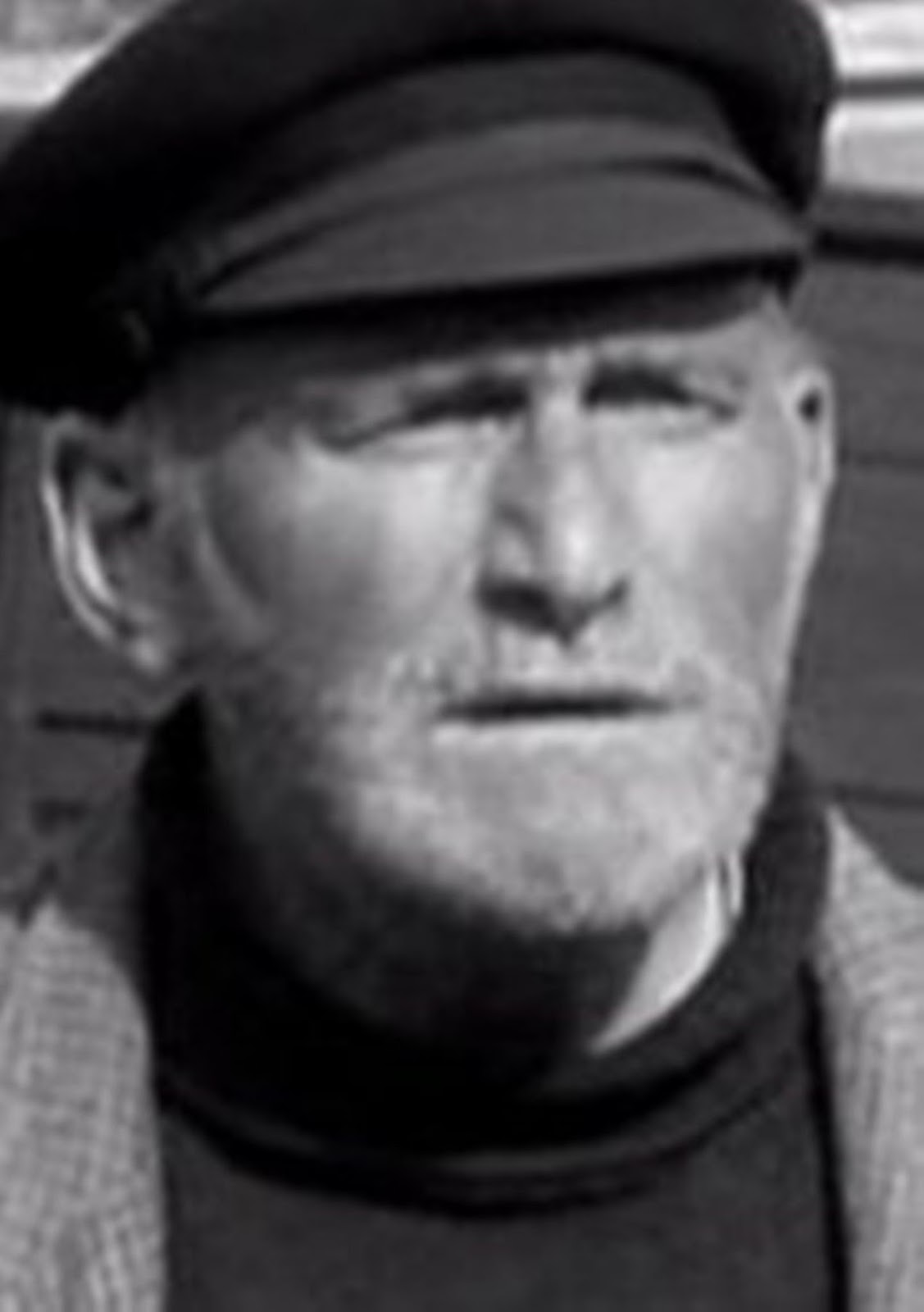
The three-hour long programme had a cast which featured Alex MacKenzie, who
would later star as the skipper in the comedy The Maggie
(1954), along with Rhona Sykes, Angus MacDonald, Duncan MacIntyre, Archie Henry,
Morven Cameron, Effie Morrison and Neil Brown together with minor parts played
by Joan Fitzpatrick, Pat Vicary and Tom Smith. Musical accompaniment by way of
Gaelic song was supplied by John MacLeod, John MacInnes, Kate Buchanan and Calum
Johnston.
The opening announcement from the radio script ably sets the scene:
1.
ANNOUNCER: “BLACK HOUSE INTO WHITE” – We present the
story of the passing of a traditional way of life in the Outer Hebrides.
The script then goes on to describe stormy Hebridean weather and then a
typical dwelling-place at the turn of the twentieth century. The influence of
Dr Werner Kissling, an expert on blackhouses, is easily discernible:
3. NARRATOR: To this day in the treeless, rocky islands of the Outer Hebrides,
the rain and the gales of the Atlantic and a ferocious sea, have made the
ordinary daily work of man into a trial strength. Thirty or forty years ago
most of the people lived in houses which had thick double walls of stone and
earth, stout enough to withstand the onslaught of the winds and to provide calm
and shelter from the violence outside. Granite stones, of suitable shapes and
sizes, were collected and built into walls, with earth and turf instead of
mortar. The rounded corners of these houses (some even had rounded end-walls),
the small roof and rounded roof ends, seemed to link them in origin with the
ancient beehive hut, and with their low solid walls they hugged the ground against
the wind. They had no windows, but where the roof joined the wall there was at
least one small hole through the thatch to let in the light and to let out some
of the smoke from the peat fire which burned on the middle of the floor. Most
of the smoke had to find its way out through the thatch; indeed it was not
intended to escape until it had lingered there and saturated the roof with peat
tar. When the thatch was so sticky and sooty that no smoke could find its way
through, it was stripped from the rafters and used as manure. But meantime the
inside of the house was thick with peatsmoke, night and day and glistening,
pitchy pendicles of black soot fringed the rafters. It was indeed a Black
House, and in character it had not changed for more than a thousand years.
It will be clear from the stories to be told in this programme –
stories, by the way which were noted down probably for the first time only a
few weeks ago – that the oral literature of the people lived in these Black
Houses had remained unchanged in character for more than a thousand years. But
so had the climate of the Atlantic coast. The Hebridean leant towards the
ideal, he concentrated on the past, and except where extreme necessity drove
him, the desire to improve the material conditions of his life was more or less
latent. But while the chance of satisfying that desire was just as remote as,
let us say, his wish to tame the wind and the sea, he could ill have dispensed
with his heritage of memories and with the ideals which gave him a motive in
living. Not that material conditions are improving, now that the small boys of
the island will discuss among themselves the merits of a jet-propelled plane
and the young men and women are interested in written literature, they must
somehow discover a new force to bind their communities together. They have
escaped the worst evils of our industrial age. Perhaps they will be able to
show us how to glean the good things from it. For their independence of mind
and their strength have not changed – and the wind and the sea and the rain
which govern the work they do – these have not changed.
As the narrator moves away from a graphic description of the
dwelling-house to that which was then the way of life in the Hebrides, the
influence of Calum Maclean can be seen. The progamme then turns to a typical
ceilidh scene:
1. RONALD: Then the man of the house would start to tell one of his stories
and all the people in the house would be silent. I learnt many such stories
from my father – some would take four or five evenings to tell, but the shorter
ones would last perhaps an hour.
Our language, as you know, is Gaelic – my mother and my father had no
English at all, and the little children had no English (no more have they
nowadays) but my brother and sisters and I had learnt English at school. So now
when we let you hard hi story, as he told it sitting by the fire, spinning
heather ropes maybe, or making horse’s harness of seabent, Ian here will put it
shortly for you in English. Much of the wonder and glory will be lost to you in
English, so I will ask you first to listen to the sound of the Gaelic and the
style it was spoken in that held our ears bound to the story of a hero.
There then follows an English translation of the tale known as The Son of the King of Lochlan. The tale
was recorded by Maclean from Duncan MacDonald, one of the very best storytellers
that Maclean had the privilege to encounter when collecting in South Uist. The
translation is clearly the work of Maclean. After the story has been narrated,
all the characters then discuss some points of the story and raise questions or
make observations of what they had heard. Thomson doubtless had discussed with
Maclean all that he had picked up about traditional ceilidhs and used his
knowledge to good effect in creating an authentic atmosphere for the radio
play.
The rest of the play continues in a similar vein in that it reproduces a
ceilidh scene of yesteryear including more Gaelic song and stories. Yet it also
contains contemporary material with mention made of the Second World War and
also local issues. Such a brief summary can hardly do justice to the vitality
and fullness of the original script never mind the actual performance of the
actors involved in the production of the radio programme. The broadcast
received some outstanding reviews: (Evening
News, 23/3/49). “This was a most fluent and exciting presentation of the
passing of a traditional way of life in the Outer Hebrides symoblised by the
gradual disappearance of the Black House. It was a rich, artistic and emotional
experience to listen to this piece which was evidently compiled in the main by
an English producer―very English, I can assure you―named David Thomson.”
Special praise is reserved for Duncan MacDonald’s performance: “There were some
fine individual performances by a mixture of professional and amateur artists.
Noteworthy was Duncan MacDonald, the traditional storyteller. He has a powerful
voice which he uses with a high sense of poetry and feeling for the past.”
Other reviews were not far behind such as the one from the Bulletin (16/3/1949): “Now that was
something―“Black House Into White” on the Third Programme! This fascinating
script on passing of a traditional way of life in the Outer Hebrides (South
Uist and Benbecula, where the oral literature had remained unchanged for a
thousand years) had a magnificent subject…Some of the recordings of the
wonderful heroic tales, ancient fruit of the age-long Ceilidhs, were made for
the first time a few weeks ago. You don’t need to be a genius to make
recordings. Ordinary common sense should have told the local men where to find
such material for their recordings.” Waxing even more lyrically was a review
from the Scottish Daily Mail (17/3/1949):
“These wonderful stories, told in the most poetic and fiery language, whirling
the mind into a starry vast by sheer power of words and imagination, are food
for our starved, drab souls…Thomson’s script, simple and well knit, was not all
fairy tales. It gave a sensitive and accurate interpretation (extremely well
acted by our local players) of the change which had come over the islands, and
of the muddled, puzzled, wandered young folk who don’t know where they are
going.” Perhaps the most realistic review was published in the Observer (20/3/1949): “…a vivid
depiction…of the primitive way of life which survives in the Outer Hebrides.
Instead of being exhibited as anthropological oddities the islanders were
revealed, in their simple dignity, coping with elemental problems for which, in
their environment, there is no solution by Wage Board, By-Law or Act of
Parliament. The singers and storytellers, all natives of the islands, had me
spellbound by their artless recital of legend and tradition. Too often we heard
these things as folk-salvage, collected by sentimentalists and displayed in the
incongruous setting of one of our lesser concert-halls. But in this stark
medium of wireless we made direct and dramatic contact with Barra and South
Uist.”
Calum Maclean’s diary entries, originally written in Gaelic but here
given in translation, reveal the buildup to the rehearsal and recording of Black House Into White.
Monday, 14 March 1949
[NFC
1300, 118–21]
In
the morning I received a message from David Thomson. He came down from London
last night and he asked to go down to the hotel where he’s staying so that we
could go up to the BBC. Hugh MacPhee was organising matters until David Thomson
arrived. He only had one day to get everything organised. Some of the folk who
were taking part in the broadcast were present. Two of them spoke Gaelic and
one of the woman, Rona Sykes from the Isle of Skye, spoke Gaelic as well. The
two men were called Angus MacDonald and Alexander MacKenzie. Angus MacDonald
came over to speak with me and he said that he had plenty of stories and he
wanted to give them to me. He gave me his address and I promised to go and
visit him the next time I’d be in Glasgow. He has the story about Uilleam bi ’d Shuidhe (Willie Sit Down),
he told me. He also told me that he has a friend in Glasgow who has many old
songs that he got in the Isle of Skye. I thought that it was pretty amazing
that I should meet a man like that at the BBC’s Broadcasting Station. Angus
MacDonald speaks good Gaelic. He hails from Kilmuir in the Isle of Skye. We
spent all day preparing from the evening broadcast. David Thomson called the
recording Black House into White.
Those that read the parts were very good. They had good voices and the right
accent with their English dialects. They went on air at quarter past eight and
the recording lasted an hour. David Thomson and I were quite tired when it was
all over. We went back to the hotel and we had one drink there. I then went
back home.
Wednesday, 16 March
1949 [NFC
1300, 123]
I
set off from Glasgow around six o’clock this morning. It was a fine morning and
I had a good journey coming home. I arrived about four o’clock in the afternoon
and found everyone well. Our programme, Black
House into White, was broadcast again tonight. I went over to the hotel to
hear it. We didn’t hear it very well at all but some of it was good enough.
Later that same year,
Maclean had the opportunity to listen to a repeat of the programme when in
Benbecula.
Sunday, 7 August 1949
[NFC
1111, 36]
I
didn’t do much worth mentioning today. I spent a while in the afternoon at the
house of Janet, Angus MacLellan’s widow as I had to do some writing for her,
writing about the late Angus’s money. I was pleased, anyhow, that he left her a
little. I then went up to Angus MacMillan’s house. Our recording, Black House into White, was broadcast on
the Scottish service tonight. We all listened to it.
Maclean’s brief stint in broadcasting had actually began five or six
years previously when he was in resident in Ireland (specifically Dublin) where
he wrote and presented a number of programmes about Gaelic and Irish. Such
experience and his undoubted ability to write attractive prose stood him in
good stead for his later (and crucial) involvement during the production of Black House Into White. David Thomson,
on the other hand, continued his successful career in broadcasting and writing
and would later pen a number of works such as The People of the Sea (1954), in which Calum Maclean’s assistance
was acknowledged, and the novel for which he is perhaps best remembered Nairn in Darkness and in Light (1987),
published a year before his death.
References:
NLS, David Thomson, Acc
10129/100
NFC 1111; 1300
[Calum Maclean’s diaries for 1949]
Image:
Alex MacKenzie during
the filming of The Maggie


